

Your childs vision
Our eyes play an important role in kids development. It allows us to take in the world around us.
Routine eye exams can keep your eyes healthy and find any vision problems.
What is Myopia and why does it affect so many children?
Myopia affects one in three people but it is indeed on the rise.
Encourage your child to play outside as much as possible and decrease screen time.
Myopia is being short sighted or near sighted. When near objects appear clear and objects further away look blurry.
When light falls in front of the retina.
Myopia continues to place an individual at an increased risk of sight-threatening diseases including glaucoma, cataract and detachments.
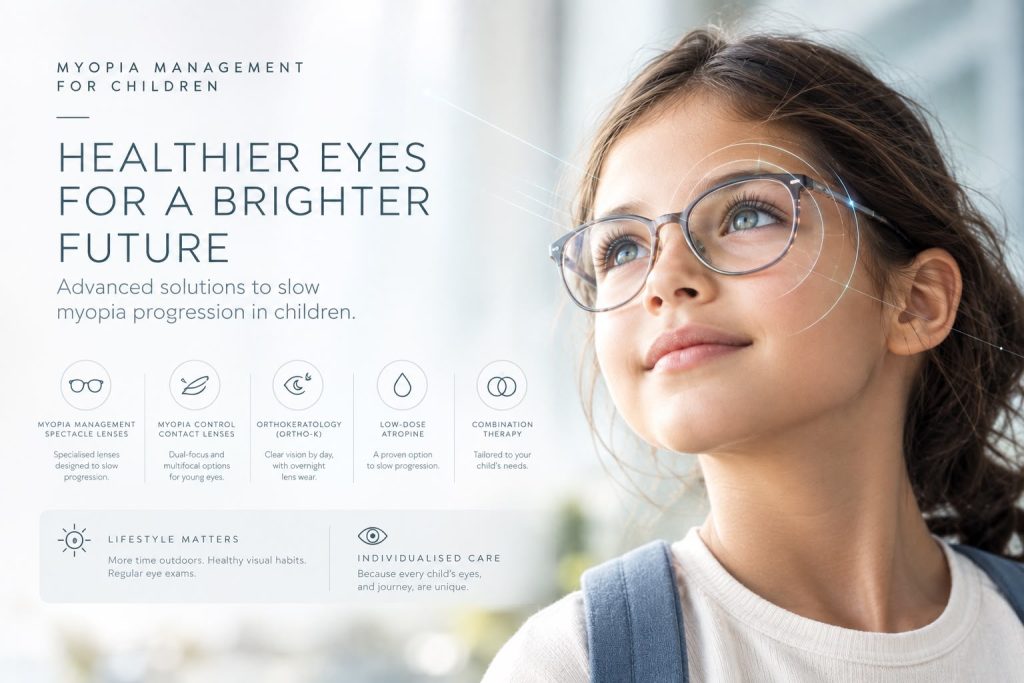
Myopia Management for Children
Clear vision today. Healthier eyes for tomorrow.
Myopia, or short-sightedness, often begins during childhood and can continue to progress as the eye grows.
Myopia management aims to slow myopia progression and excessive eye growth, helping reduce the likelihood of higher levels of myopia later in life.
Treatment Options
Depending on your child’s age, prescription and individual needs, options may include:
* Myopia management spectacle lenses
* Specialised contact lenses
* Orthokeratology (Ortho-K)
* Low-dose atropine
* Combination treatment
Lifestyle also plays an important role. Regular outdoor time, healthy visual habits and appropriate near-working distances can support your child’s visual development.
At Thinc Vision, we provide personalised myopia management with ongoing monitoring of your child’s prescription, eye health and eye growth.
Because managing myopia early can make a difference to the eyes your child grows into
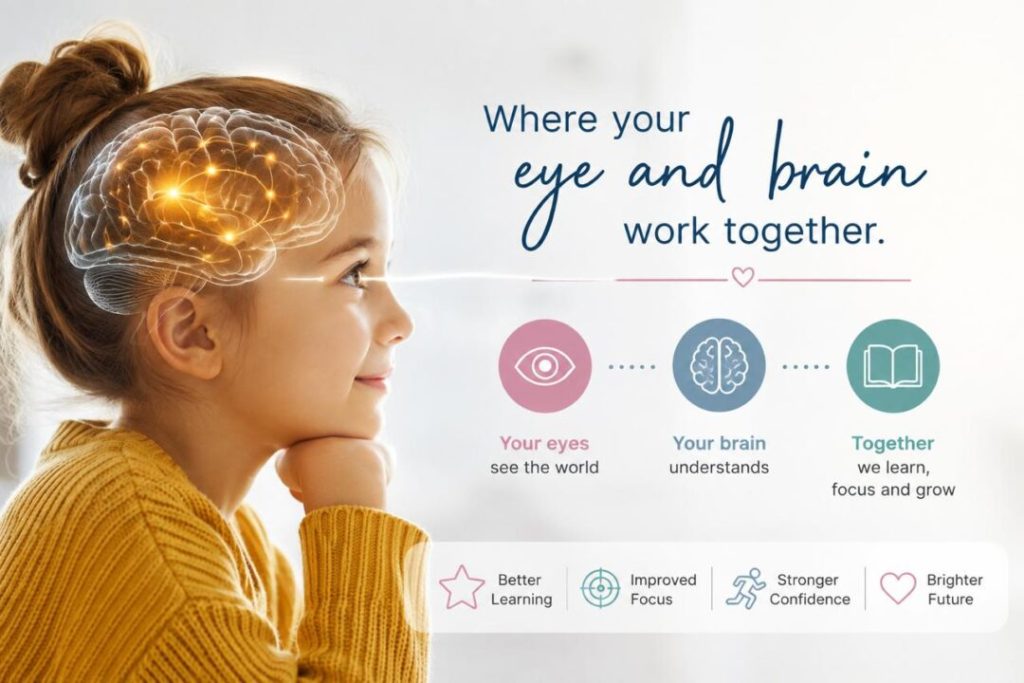
Behavioural Optometry
Helping children see, learn and perform at their best.
Vision is about more than simply seeing clearly. A child’s visual system plays an important role in reading, learning, concentration, coordination and overall confidence.
Behavioural Optometry takes a deeper look at how the eyes and brain work together and how visual skills may be influencing a child’s ability to learn and perform comfortably.
Our comprehensive assessments evaluate skills such as eye tracking, focusing, eye teaming, visual processing and spatial awareness. When challenges are identified, an individualised programme may be recommended to develop and strengthen these essential visual skills.
At Thinc Vision, we look beyond the eye chart to understand the whole visual system — helping every child develop the visual skills they need to learn with confidence and reach their full potential.

Are you reading comfortably?
Do words appear to move, wobble or flicker when you read for any length of time? Do your eyes get tired or do you get headaches when reading? You might be one of the 20% of the population who suffers from a condition known as Visual Stress.
Visual Stress is thought to be caused by hyperactivity of certain groups of cells in the brain. The good news is that the symptoms can often be reduced by using a coloured overlay, coloured lenses or by changing the background colour of the screen or tablet that you are looking at.
The ReadEZ system was developed at City University London by a team led by optometrist and visual scientist, Professor David Thomson. The system is used by over 400 Opticians and in many hospitals and schools and our coloured overlays, coloured lenses and screen tinting software are now used by 1000s of people around the world.

Dyslexia screening and assessment
When a child struggles with reading, writing or keeping up in the classroom, understanding why can make all the difference.
At Thinc Vision, we offer dyslexia screening and assessment using the Stark-Griffin approach, alongside a comprehensive assessment of the visual skills that support learning.
Vision is more than simply seeing clearly. Children need to be able to focus, track, coordinate their eyes, process visual information and efficiently move between near and far tasks. Difficulties with these skills can sometimes make reading and learning more challenging.
Our assessment helps identify areas of visual difficulty that may be contributing to a child’s learning experience and provides valuable information to guide appropriate support and referral where necessary.
Our goal is simple: to understand how your child’s visual system is supporting their learning — and where we can help.
Early identification and the right support can give children greater confidence and help them reach their full potential.